From research and international workshops to practical guidelines, local dialogue and a Mediterranean network of youth workers
For two years, youth workers and civil-society organisations from across the Mediterranean worked together through YW-MED – Youth Workers Network Across the Mediterranean Sea to address a shared challenge: how can international youth activities become safer, more welcoming and genuinely inclusive for LGBTQIA+ young people?
YW-MED was not designed as a simple sequence of international meetings. It was developed as a gradual process that moved from research and needs analysis to participatory workshops, practical tools, public awareness activities and the creation of a long-term network for cooperation.
As the project approaches the end of its formal implementation period, Youth Horizons looks back at the work carried out, the results created and the relationships built across the Mediterranean.
Project information
Project title: Youth Workers Network Across the Mediterranean Sea – YW-MED Project reference: 2024-1-IT03-KA220-YOU-000243233 Programme: Erasmus+ – Cooperation Partnership in Youth Implementation period: 1 September 2024 – 31 August 2026 Coordinator: GAYCS LGBT Associazione di Promozione Sociale, Italy Greek partner: Youth Horizons – Neanikoi Orizontes M.K.O.
The partnership brought together organisations from Italy, Greece, Spain, Albania, Malta, Jordan and Türkiye:
GAYCS LGBT Associazione di Promozione Sociale – Italy
Youth Horizons – Greece
Euro Mirada – Spain
Open Mind Spectrum Albania – Albania
International E-Learning Institute Ltd – Malta
Al-Emad Alkabeer for Training and Development Co. – Jordan
International Youth, Sport, Environment and Development Association – Türkiye
The project involved 24 youth workers from the partner countries and used participatory design to develop research, practical resources and opportunities for long-term regional cooperation.
Why was YW-MED created?
The Mediterranean is a region connected by history, migration, culture and exchange. At the same time, its countries have very different legal frameworks, social attitudes and institutional approaches concerning sexual orientation, gender identity and LGBTQIA+ inclusion.
These differences can directly affect young people participating in international activities. A young person who feels safe and recognised in one country may face stigma, invisibility, discriminatory language or fear of disclosure in another. Youth organisations may also have very different levels of experience, training and institutional support.
YW-MED was created to improve the quality of youth work throughout the Mediterranean and to strengthen the inclusion of LGBTQIA+ young people in Erasmus+ youth exchanges and non-formal education activities, particularly in contexts where acceptance and the protection of LGBTQIA+ rights remain difficult.
The project aimed to equip youth workers with practical tools, encourage cooperation between organisations and create an international network extending across the Mediterranean region.
The intended results included:
comparative research on LGBTQIA+ inclusion and good practices;
a transnational survey among youth workers and youth organisations;
practical guidelines for inclusive youth exchanges;
the creation of the Mediterranean Youth Workers Network;
awareness-raising and dissemination activities;
monitoring, validation and impact assessment.
Building the partnership: the kick-off meeting in Amman
Although the formal project period began in September 2024, the partnership came together physically for its kick-off meeting in Amman, Jordan, on 5 February 2025.
The meeting marked the transition from preparation to implementation. The partners agreed on the operational agenda, monitoring procedures, communication arrangements, visual identity and the structure of the activities that would follow.
However, Amman was not only an administrative meeting. It gave the participating organisations the opportunity to meet, exchange perspectives and begin building trust across seven different national and organisational contexts.
For a project dealing with a topic that can be approached very differently across the Mediterranean, this initial relationship-building was essential. It established the cooperation needed for honest dialogue during the research, workshops and later development of the project’s practical outputs.
Understanding the different realities of LGBTQIA+ young people
The first major stage of YW-MED focused on research.
The 24 participating youth workers examined the situation of LGBTQIA+ young people in the seven partner countries. The process combined desk research with interviews, participatory workshops, field reports and information collected through local engagement.
The resulting publication, “Research Report: The Situation of Young LGBTQIA+ People in Partner Countries,” compared the political, economic, social, technological, legal and environmental conditions affecting LGBTQIA+ inclusion in Italy, Greece, Spain, Albania, Malta, Jordan and Türkiye.
Its purpose was not simply to produce seven separate country descriptions. The research aimed to identify common challenges, differences between legal protections and lived realities, examples of good practice and areas where youth workers could make a meaningful contribution.
One of its central conclusions was that legal recognition, although essential, does not automatically create safety or social acceptance. Laws must be supported by effective implementation, inclusive education, institutional commitment, positive public narratives and community-based action.
The research also underlined the importance of youth workers as intermediaries between institutions and young people. Youth workers can challenge stereotypes, recognise gaps in support, facilitate access to information and create spaces in which young people feel listened to and respected.
Among the report’s recommendations were:
providing intersectional and practical training for youth workers;
supporting inclusive educational approaches;
strengthening local LGBTQIA+ organisations, particularly outside major cities;
creating Mediterranean platforms for exchanging practices and lived experiences;
investing in transnational youth activities and long-term cooperation.
These findings provided the foundation for the later stages of YW-MED.
Tirana: turning research into participatory action
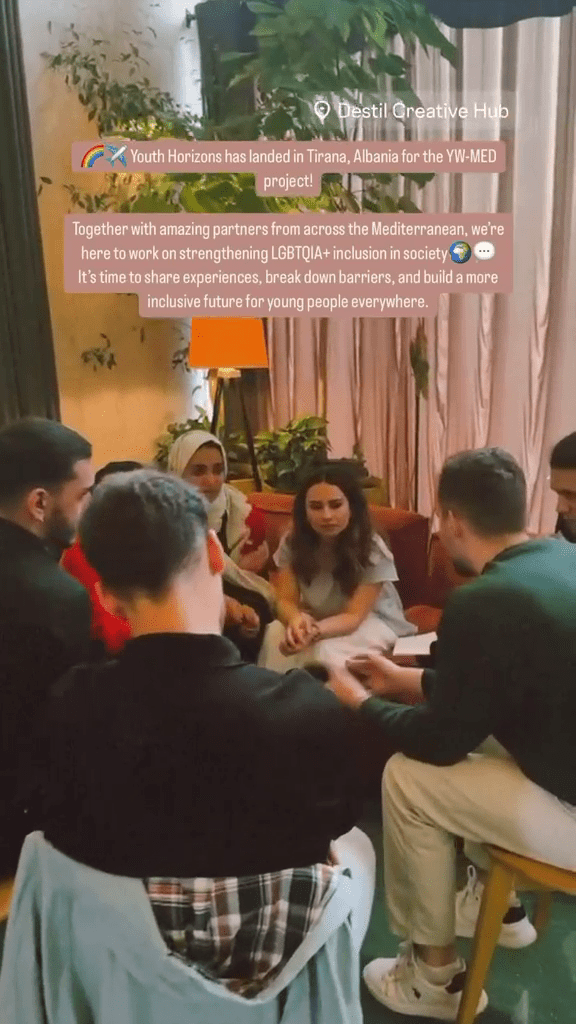
The next major project activity took place in Tirana, Albania, from 21 to 25 May 2025.
The mobility brought together 24 youth workers from all seven partner countries. At the centre of the programme was participatory design: an approach that involves the people affected by an issue in the development of the responses and tools intended for them.
During the international workshop, participants presented the results of their national research and compared the different realities identified across the partnership. They explored how culture, language, organisational practices, family expectations and institutional conditions can influence the participation of LGBTQIA+ young people.
The participants then worked together to identify the main indicators for a transnational survey. They helped structure the questionnaire that would later be distributed among youth workers, organisations and professionals working in the social and educational sectors.
The workshop also connected research with communication. Participants created awareness-raising materials to accompany the survey and discussed how to reach people through Instagram, Telegram, WhatsApp, email and partner networks.
Youth Horizons contributed to this communication process by sharing the survey and YW-MED content through its own online channels.
Learning, visibility and Tirana Pride
The Tirana activity also extended beyond the workshop room.
With the support of the Albanian partner OMSA, participants joined activities organised during Pride Week and took part in the Tirana Pride parade.
This experience placed the project’s discussions within a visible public and community setting. Research, inclusion and rights were no longer abstract concepts: participants encountered local activism, community voices and the importance of public solidarity.
For the Youth Horizons team, participating in Tirana Pride was an important expression of support for equality, dignity and the right of every young person to take part in society without hiding who they are.
Listening to youth workers across the Mediterranean
Following the Tirana workshop, the partnership launched the YW-MED transnational survey.
The questionnaire focused on five central areas:
self-assessed knowledge of LGBTQIA+ rights and inclusion;
previous participation in formal training;
willingness to support inclusion through professional practice;
barriers experienced by youth workers;
institutional climate and support needs.
The survey collected 200 valid responses through the partners’ communication channels and professional networks. Because participation was voluntary and non-random, the report presents the results as an exploratory needs assessment rather than a statistically representative picture of all Mediterranean youth workers.
Nevertheless, the responses revealed several important patterns.
The average self-assessed knowledge score was 3.1 out of 5, indicating a moderate level of perceived understanding. However, only 36% of respondents had received formal training specifically addressing LGBTQIA+ issues, while 64% had not.
This indicated that much of the existing knowledge came through personal experience, peer learning, self-directed research, participation in projects or proximity to LGBTQIA+ communities rather than structured professional training.
At the same time, willingness to engage with LGBTQIA+ inclusion was generally high. The challenge was therefore not primarily a lack of motivation, but a gap between positive intentions and access to practical knowledge, confidence and organisational support.
Cultural and social resistance emerged as the most frequently reported barrier. Respondents also identified limited awareness, insufficient professional expertise, legal or regulatory difficulties, fear of negative reactions and limited institutional or financial support.
Approximately one in four respondents reported having experienced pressure not to address LGBTQIA+ matters within their professional environment. This demonstrated that even motivated youth workers may limit their actions when they fear organisational, social or professional consequences.
The open responses also highlighted concerns about polarisation, intercultural misunderstanding and the fear of using inappropriate language. These findings directly influenced the project’s next stage, particularly its focus on inclusive communication, conflict management and adaptable tools for different cultural contexts.
The second international workshop took place in Rome on 21 and 22 November 2025.
This meeting transformed the research and survey findings into a practical resource for youth workers.
On the first day, hosted at the GAYCS operational office, participants examined the national research, the needs identified through the survey and examples of inclusive practice. Working in groups through participatory design, they began developing the central content of the YW-MED Guidelines.
Their work focused on:
practical measures for making youth exchanges more inclusive;
prevention of discrimination based on sexual orientation or gender identity;
the wellbeing, safety and active participation of LGBTQIA+ young people;
tools adaptable to different national, cultural and organisational realities.
On the second day, the partners met at Coming Out, a long-standing LGBTQIA+ community venue in Rome. The working groups presented their prototypes, exchanged feedback and further developed the intercultural and Mediterranean dimension of the document.
The workshop combined technical work with dialogue and community connection. It also strengthened the relationships among the youth workers who would form the basis of the future Mediterranean network.
Practical Guidelines for inclusive youth exchanges
One of the project’s principal outputs is the YW-MED Guidelines for Youth Workers on LGBTQIA+ Inclusive Youth Exchanges.
The Guidelines were designed as both a theoretical and an operational resource for youth workers, trainers and facilitators planning international youth activities.
Rather than addressing inclusion only as a matter of good intentions, they examine the concrete decisions that shape participants’ experiences before, during and after an activity.
The document is organised around three interconnected areas:
Environment
This includes the physical, organisational, emotional and symbolic space of an activity.
The Guidelines address matters such as preparatory meetings, accessible accommodation, privacy, gender-neutral facilities, safe spaces, dietary and individual needs, emotional check-ins and support systems.
Group dynamics
This concerns relationships, participation, roles and power within the group.
The proposed practices include balanced participation, mixed-nationality cooperation, clear group agreements, support for people with limited language skills, daily reflection and active responses to stereotypes or discriminatory behaviour.
Inclusive language
Language is treated not only as a means of communication but also as something that can either support recognition or reinforce exclusion.
The Guidelines recommend avoiding assumptions about gender and pronouns, using clear and accessible communication, listening without interruption, seeking consent before giving personal feedback and addressing discriminatory language in an educational and respectful manner.
Each of these three areas is examined through six perspectives:
Fears, Prejudices, Challenges, Support, Encouragement and Valorisation.
This helps youth workers identify possible risks while also considering how participants can be supported, empowered and valued.
The content was evaluated by the youth workers involved in its creation and by 20 LGBTQIA+ young people from the partnership countries. According to the project document, each section received a satisfaction level of at least 70%, supporting the relevance and practical applicability of the material.
Athens: connecting European results with local realities
On 8 February 2026, Youth Horizons hosted the YW-MED Closing Meeting at Europa Experience Athens.
Although described as the Closing Meeting, the activity took place several months before the formal end of the project. It was therefore designed not only as a moment of reflection, but also as a transition towards final dissemination, sustainability and future cooperation.
The programme followed seven stages:
Arrival, The Story So Far, Local Voices, Dialogue, Validation, Commitment and Closure.
The day began with a visit to the Europa Experience exhibition, connecting the project with broader European values of participation, cooperation, rights and active citizenship.
During the working sessions, the partnership reviewed the project’s journey, including:
national research and shared evidence;
transnational learning;
the survey and identified needs;
co-creation of practical tools;
development of the Mediterranean network;
local engagement and awareness activities.
The meeting also created space for local voices and lived experience. Local contributors and activists enriched the discussion by connecting the European project results with realities faced by LGBTQIA+ people and youth workers in Greece.
Guest contributor Gürol Başdar shared his perspective and supported reflection on the importance of Euro-Mediterranean cooperation, professional networks and youth work in complex social contexts.
Dialogue through the Fishbowl method
A Fishbowl Conversation was used to encourage active participation.
In this method, a smaller discussion group sits at the centre while other participants listen, observe and gradually rotate into the conversation. The format supported active listening and allowed different perspectives to be expressed without turning the activity into a conventional presentation.
Validating the project’s value
Participants also evaluated the project through Mentimeter.
When asked which aspect of YW-MED had the strongest real-life value, cooperation received the highest ranking. It was followed by the Guidelines, the Network, inclusion and safety.
All 12 respondents assessed the project outputs positively:
four described them as usable;
five described them as mostly useful;
three considered them ready to apply in society;
nobody selected “not usable yet” or “needs improvement.”
Participants identified awareness actions, additional practical tools, training opportunities and expansion of the Mediterranean network as the most important priorities for the project’s legacy.
They also recommended stronger direct involvement of LGBTQIA+ people and their stories, further local activities, clearer impact measurement, cooperation with additional countries and continued planning among the participating organisations.
In the final word cloud, “perspective” was the most prominent word, followed by “inclusion.” Other words included diversity, equality, acceptance, freedom, future, change, love and challenge. One response summarised the continuing journey with the phrase:
“The way is long but right.”
Launching the Mediterranean Youth Workers Network
The project’s ambition was not limited to producing documents. It also aimed to connect professionals who could continue exchanging knowledge and developing joint initiatives after the funded period.
On 27 April 2026, the International Forum of Youth Workers in the Mediterranean took place online through the dedicated YW-MED Facebook group.
More than 200 youth workers, practitioners and stakeholders from seven Mediterranean countries participated. The Forum officially launched the Mediterranean Youth Workers Network as a space for professional connection, exchange and longer-term cooperation.
During the event:
practitioners and international contributors joined thematic discussions;
tools and good practices were presented;
new contacts and possible partnerships were developed;
a common vision for Euro-Mediterranean youth-work cooperation was discussed.
The full Forum was also recorded and made publicly available online, allowing the discussions and project messages to reach people beyond the live participants.
The network is intended to continue developing by welcoming new youth workers and organisations, sharing opportunities and supporting future international projects.
Sharing the project with wider audiences
Throughout its implementation, YW-MED was presented through partner websites, social media, awareness materials, online communication and stakeholder events.
The project was introduced to public and professional audiences during the Queer Culture Festival in Rome in September 2025, where its objectives, research and planned network were discussed with associations, youth workers, institutions and citizens.
Further dissemination events took place in May 2026 at Rome Municipality V and the Regional Council of Lazio. These events presented the research, survey, Guidelines, network and awareness activities to representatives of institutions, youth organisations, civil society and the wider community.
These activities helped move YW-MED beyond the immediate partnership and positioned its results within wider discussions concerning inclusion, non-formal education, youth participation and human rights.
Youth Horizons’ contribution
As the Greek partner, Youth Horizons participated throughout the development of YW-MED.
Our contribution included:
supporting the implementation and coordination of the project;
contributing the Greek perspective to the comparative research;
participating in the kick-off meeting in Amman;
taking part in the participatory workshop and Pride activities in Tirana;
contributing to the design and dissemination of the transnational survey;
participating in the Rome co-creation workshop;
contributing ideas, experiences and feedback to the Guidelines;
communicating project activities and results through our channels;
hosting and supporting the Closing Meeting at Europa Experience Athens;
connecting the transnational project with local perspectives in Greece;
contributing to the project’s validation, dissemination and sustainability discussions.
Youth Horizons was founded in Megara with the aim of creating opportunities that allow young people to broaden their horizons locally and internationally.
Our participation in YW-MED reflected one of the central values of our organisation: differences and borders should not become barriers. Youth work must create opportunities for people to participate, learn and express themselves with dignity and safety.
What remains after the project?
YW-MED demonstrated that inclusion cannot be created through a single workshop, publication or awareness campaign.
It requires continued learning, the willingness to listen, practical organisational change and cooperation with the people whose lives are directly affected.
The project also showed that the Mediterranean’s differences do not have to prevent cooperation. They can help youth workers understand why methods must be adaptable, culturally sensitive and rooted in local realities while remaining firmly connected to human rights.
As the YW-MED implementation period approaches its formal completion, the work continues through:
use and dissemination of the Guidelines;
further awareness and educational activities;
continued connection among participating youth workers;
development of new partnerships and project ideas;
expansion of the Mediterranean Youth Workers Network;
application of the project’s learning within local and international activities.
For Youth Horizons, YW-MED was an opportunity to learn from different Mediterranean realities, contribute our own experience and reaffirm our commitment to youth work based on dignity, inclusion, dialogue and participation.
The formal project may be coming to an end, but the cooperation, tools and perspectives created through it can continue to grow.
This is not the end. We will continue to create, make an impact and be a voice.
European Union funding acknowledgement
This project was funded by the European Union through the Erasmus+ Programme. The content and opinions expressed belong to the authors and do not necessarily represent the position of the European Union or EACEA, which cannot be held responsible for them.